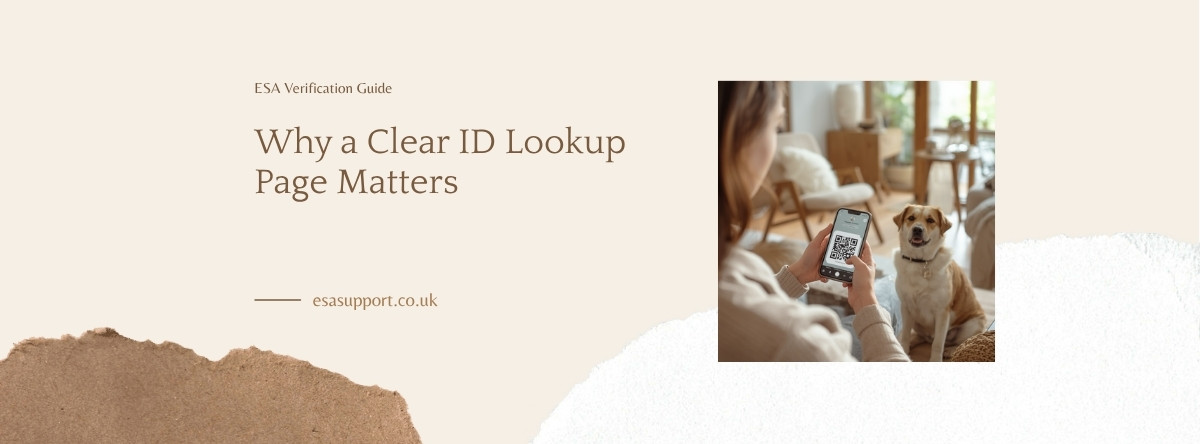
- A verbal claim that you have an ESA is easy to dismiss. A scannable QR code that loads a live, professional verification page is much harder to ignore.
- ESA Support's ID lookup page shows animal name, photo, registration ID, and active status - giving third parties a clear, credible confirmation in seconds.
- Landlords, employers, hotels, and vets are all more likely to engage positively when you can point to documented, independently verifiable information.
- In the absence of a clear UK legal framework for emotional support animals, professional documentation is one of the most practical tools an ESA owner has.
The Verification Gap
There is a practical problem that most ESA owners in the UK encounter sooner or later. They know their animal is important to their wellbeing. The people around them - landlords, employers, accommodation managers - often do not have a clear way to understand or verify that claim. The result is an awkward, sometimes stressful conversation that starts from a position of doubt.
This is not because those third parties are unreasonable. It is because they have no way to check. When someone tells a landlord they have an emotional support animal, the landlord has two options: take the person's word for it, or decline. There is no registry they can search. No QR code to scan. No independent confirmation. Most people default to caution, and that often means a "no".
This is the verification gap. And it is the reason why a clear, professional, publicly accessible ID lookup page makes a material difference to ESA owners in day-to-day life.
Without Verification
"I have an emotional support animal - she really helps with my anxiety." The landlord nods politely and says they'll think about it. They never follow up. The conversation goes nowhere.
With Verification
"Here is Bella's registration on ESA Support - you can scan this QR code to see her verified profile." The landlord scans it, sees the active registration, and the conversation moves forward on different footing.
How the ID Lookup Page Works
Every animal registered on ESA Support gets a unique public profile page. This page is hosted on our servers at a permanent URL in the format esasupport.co.uk/verify/[registration-id]. It is live from the moment registration is processed and remains accessible as long as the registration is active.
The page is designed to be functional on any device - desktop, tablet, or mobile - and loads in under two seconds even on a mobile connection. It uses no heavy scripts or trackers. The goal is that the third party gets a clear answer as fast as possible.
The lookup page can be accessed in three ways:
- QR code scan - the fastest method. Printed on your physical digital ID card. The phone camera opens the page directly in the browser.
- Direct URL - you can share the link with anyone via text, email, or messaging app.
- Manual registration ID search - third parties can visit esasupport.co.uk/verify and type in your registration ID number if they prefer not to use the QR code.
All three methods arrive at the same page. The experience is identical regardless of how someone reaches it.
What Third Parties See
The lookup page is deliberately minimal. It answers the one question a third party is asking - "Is this registration genuine and active?" - without exposing any private information about the owner.
A third party who scans your QR code will see:
- Your animal's name and photo, clearly displayed at the top
- Species and type (for example: "Dog - Golden Retriever")
- The unique registration ID number - the same one printed on your card
- Registration date - showing how long the registration has been active
- Current status - a clearly labelled green "Active" badge
- The ESA Support registry verification mark at the bottom of the page
They will not see your home address, your full name, your medical history, or any clinical information. The profile is privacy-first - it discloses only what is necessary to confirm the registration.
The registration ID number on the lookup page matches the number printed on your physical digital ID card. This three-way consistency - card, live page - is what makes the verification credible. A third party cannot easily question whether the card is genuine when it matches a live online record with the same number.
Get Your ESA's Verification Profile Live Today
A QR-linked public profile, digital ID card, and optional printed ID card. Set up in under 10 minutes.
View Plans and RegisterThe QR Code Flow Step by Step
Here is exactly what happens from the moment a third party scans your QR code to the moment they have the information they need:
-
They open their phone camera No app download required. Any modern smartphone camera can read a QR code natively. They point it at your digital ID card.
-
A notification appears The camera app shows a banner at the top of the screen: "Open esasupport.co.uk". They tap it.
-
The browser opens the lookup page They land directly on your animal's public verification profile. No login required. No pop-ups. The page loads within two seconds.
-
They see the animal's name and photo immediately The profile is designed so the most important information - name, photo, and active status badge - is visible without any scrolling.
-
They scroll to confirm the registration details Registration ID, registration date, and species are all visible below the fold. They can cross-reference the ID with the number printed on your card.
-
They see the ESA Support verification mark At the bottom of the page, the ESA Support registry badge confirms this is a live, maintained registry record - not a static document that could have been fabricated.
The entire flow takes under 30 seconds from scan to confirmation. This speed and simplicity is part of why the QR code approach works so well in practice - it removes friction from a conversation that is often already slightly tense.
Landlords and Housing
Housing is the most common area where ESA owners face practical difficulties in the UK. While the Equality Act 2010 provides some protections for people with disabilities, it does not give ESA owners an automatic right to keep their animal in rented accommodation. The decision rests with the landlord.
What this means in practice is that your ability to keep your ESA in a rented property often depends on how the conversation with your landlord goes. And that conversation goes better when you arrive with documentation rather than just a verbal explanation.
"When someone shows me a printed card with a QR code that goes to a real website with my pet's photo and a registration number, that's a very different conversation to someone just telling me their dog is for emotional support."
- Feedback shared by an ESA Support member, 2026A landlord who scans your QR code and sees a professional, live registration profile is likely to take your request more seriously. It signals that you have made an effort to document your animal's role formally - and that itself communicates a level of commitment and seriousness that a verbal claim alone does not convey.
It does not guarantee a yes. No documentation can do that under UK law. But it shifts the conversation from "I need to take your word for it" to "I can see this is a registered, documented animal". That shift matters.
Employers and Workplaces
Bringing an ESA into a workplace is less common than housing, but it does happen - particularly in smaller offices, creative environments, or where a specific welfare arrangement has been discussed with HR.
In a workplace context, the ID lookup page serves a slightly different purpose. Rather than simply confirming existence, it helps legitimise the conversation before it starts. An employee who approaches HR with a printed ID card and a live verification link is approaching a sensitive conversation with more credibility than one who simply makes a request.
Employers may also want to see documentation as part of a reasonable adjustments discussion under the Equality Act 2010, if the ESA is connected to a recognised disability. While ESA Support documentation is not clinical evidence and should not be presented as such, it is a useful supporting document alongside any formal medical information your GP or specialist might provide.
Other Situations Where Lookup Helps
Hotels and Holiday Accommodation
Many UK hotels allow pets but have separate policies for assistance or support animals. A quick QR code scan during check-in can smooth conversations about room allocation, deposits, or policy exceptions.
Veterinary Practices
Some vet practices prioritise registered support animals for appointments or have specific welfare flags they add to records. A registration profile helps establish context when discussing your animal's role in your care.
Public Transport and Taxis
Taxi drivers and bus operators have discretion over animals in their vehicles. A professional registration card often results in a more cooperative conversation than relying on a verbal explanation.
Shared Housing and HMOs
In shared houses or HMOs, you may need to convince both a landlord and co-residents. A documented registration gives both parties something concrete to refer to in any house policy discussion.
In all of these situations, the pattern is the same: the lookup page provides a credible, independent reference point. It moves the conversation from "trust me" to "here is something you can check". That shift in dynamic is consistently more productive.
Documentation Fills the Legal Gap
The UK does not have a specific legal framework for emotional support animals comparable to the Americans with Disabilities Act in the United States. There is no single piece of legislation that grants ESA owners clearly defined rights in housing, employment, or public spaces. This is simply the current state of UK law, and it is worth being honest about.
What this means for ESA owners is that much of their experience depends on the goodwill and discretion of the people they deal with. A landlord can say no. An employer can say no. A hotel can say no. The law does not currently compel them to say yes simply because an animal has been called an emotional support animal.
But "goodwill and discretion" is not a fixed quantity. It responds to how a request is made. It responds to professionalism, clarity, and the sense that the person asking has taken the matter seriously. Documentation - even private registry documentation - shifts the balance by demonstrating seriousness and providing a verifiable reference point.
This is not a claim that documentation creates legal rights. It does not. ESA Support is a private registry and we are clear about that. What documentation does is help you make the best possible case in situations where the outcome depends on a human decision rather than a legal obligation. In the UK in 2026, that is what the practical landscape looks like for ESA owners - and that is why a clear, professional ID lookup page matters.
If you believe you have legal rights connected to your disability that relate to keeping your ESA - for example under the Equality Act 2010 - we recommend seeking advice from a qualified solicitor or Citizens Advice. ESA Support documentation is a useful supporting tool but is not a substitute for legal advice in complex situations.
Glossary
- ID Lookup Page
- The public verification page hosted at esasupport.co.uk/verify/[registration-id] that displays an animal's registration details and can be accessed by scanning a QR code or visiting the URL directly.
- QR Code
- A scannable matrix barcode printed on ESA Support ID cards. When scanned with a smartphone camera, it opens the animal's public verification profile directly in the browser.
- Verification
- The process by which a third party - such as a landlord or employer - confirms that an animal's registration is genuine and currently active by checking the ESA Support lookup page.
- Registration ID
- A unique alphanumeric code assigned to each registration. Printed on the digital ID card, and displayed on the public lookup page. Used for cross-referencing and manual search.
- Reasonable Adjustment
- A change an employer or service provider is required to make under the Equality Act 2010 to avoid putting a disabled person at a substantial disadvantage. Whether keeping an ESA constitutes a reasonable adjustment depends on individual circumstances.
- Equality Act 2010
- UK legislation protecting people with disabilities from discrimination in employment, housing, and service provision. Does not specifically address emotional support animals but may be relevant in some disability-related contexts.
- Private Registry
- A documentation and registration service operated by a private company rather than a government body. Registration on a private registry does not create statutory legal rights, but provides professional documentation that can support conversations with third parties.
Sources and Further Reading
- Equality Act 2010 - legislation.gov.uk
- Citizens Advice - Disability discrimination - citizensadvice.org.uk
- ACAS - Disability at work - acas.org.uk
- Mental Health Foundation - Pets and mental health research - mentalhealth.org.uk
- GOV.UK - Guide dogs and assistance dogs: your rights - gov.uk
- RNIB - Assistance dogs and the law - rnib.org.uk